 0000-0002-2130-2847
  yahaya.wo@unilorin.edu.ng
Hassan Kobe Ibrahim1
0000-0002-2673-5350 ibrahim.hh@unilorin.edu.ngAbdulrasaq Oladimeji Akanbi1
0000-0001-7291-2090 akanbi.ao@unilorin.edu.ng
Mendive. Journal on Education, October-December 2025; 23(4), e4211
Translated from the original in Spanish
Original article
Extracurricular activities in science as a mediating variable: Predicting career choice in engineering
Actividades extracurriculares en ciencias como variable mediadora: Predicción de la elección de carrera en ingeniería
Atividades extracurriculares em ciências como variável mediadora: prevendo a escolha da carreira em engenharia
Wasiu Olayinka Yahaya1 0000-0002-2130-2847 yahaya.wo@unilorin.edu.ng
Hassan Kobe Ibrahim1 0000-0002-2673-5350 ibrahim.hh@unilorin.edu.ng
Abdulrasaq Oladimeji Akanbi1 0000-0001-7291-2090 akanbi.ao@unilorin.edu.ng
1 University of Ilorin. Nigeria.
Received: 1/04/2025
Accepted: 15/10/2025
ABSTRACT
Students' interest in STEM careers is influenced by various factors. Elements such as physics identity and science-related experiences outside the classroom play a fundamental role in career choices in science, technology, engineering, and mathematics. This study analyzes the relationship between interest, competence, and recognition in physics, and career choice in engineering, as well as the influence of extracurricular activities on this relationship. Responses from 282 engineering students, collected via a Google Form, were used. The results revealed that career choice in engineering is correlated with interest, competence, and recognition in physics. Mediation analysis showed that this choice is significantly related to competence and recognition in physics, but not to interest, when activities and experiences outside the science classroom are involved. The study concludes that interest, competence, recognition in physics, and extracurricular activities significantly predict career choice in engineering. Keywords: Extracurricular activities in science, career choice in engineering, interest in physics, competence in physics, recognition in physics.
Keywords: extracurricular activities in science; career choice in engineering; interest in physics; competence in physics; recognition in physics.
RESUMEN
El interés de los estudiantes por las carreras STEM está influenciado por diversos factores. Elementos como la identidad en física y las experiencias fuera del aula de ciencias desempeñan un papel fundamental en la elección de carreras en ciencia, tecnología, ingeniería y matemáticas. Este estudio analiza la relación entre el interés, la competencia y el reconocimiento en física, y la elección de carrera en ingeniería, así como la influencia de las actividades extracurriculares en dicha relación. Se utilizaron las respuestas de 282 estudiantes de ingeniería, recopiladas mediante un formulario de Google. Los resultados revelaron que la elección de carrera en ingeniería se correlaciona con el interés, la competencia y el reconocimiento en física. El análisis de mediación mostró que dicha elección se relaciona significativamente con la competencia y el reconocimiento en física, pero no con el interés, cuando intervienen actividades y experiencias fuera del aula de ciencias. El estudio concluye que el interés, la competencia, el reconocimiento en física y las actividades extracurriculares predicen significativamente la elección de carrera en ingeniería. Palabras clave: Actividades extracurriculares en ciencias, elección de carrera en ingeniería, interés en física, competencia en física, reconocimiento en física.
Palabras clave: actividades extracurriculares en ciencias; elección de carrera en ingeniería; interés en física; competencia en física; reconocimiento en física.
RESUMO
O interesse dos alunos por carreiras em STEM (Ciência, Tecnologia, Engenharia e Matemática) é influenciado por diversos fatores. Elementos como a identidade com a física e experiências relacionadas à ciência fora da sala de aula desempenham um papel fundamental nas escolhas de carreira nessas áreas. Este estudo analisa a relação entre interesse, competência e reconhecimento em física e a escolha de carreira em engenharia, bem como a influência de atividades extracurriculares nessa relação. Foram utilizadas as respostas de 282 estudantes de engenharia, coletadas por meio de um formulário do Google. Os resultados revelaram que a escolha de carreira em engenharia está correlacionada com o interesse, a competência e o reconhecimento em física. A análise de mediação mostrou que essa escolha está significativamente relacionada à competência e ao reconhecimento em física, mas não ao interesse, quando atividades e experiências fora da sala de aula de ciências são consideradas. O estudo conclui que o interesse, a competência, o reconhecimento em física e as atividades extracurriculares predizem significativamente a escolha de carreira em engenharia. Palavras-chave: Atividades extracurriculares em ciências, escolha de carreira em engenharia, interesse em física, competência em física, reconhecimento em física.
Palavras-chave: atividades extracurriculares em ciências; escolha da carreira em engenharia; interesse em física; proficiência em física; reconhecimento em física.
INTRODUCTION
Physics identity influences students' career choices in STEM fields. Potvin and Hazari (2014) argue that physics and mathematics identities are multidimensional constructs that include competence/performance, recognition, and belief in interest. These authors attribute students' performance, competence, recognition, and interest in physics to their choice of STEM careers. In contrast, Verdin and Godwin (2017) suggest that first-generation university students with a strong physics identity tend to be more interested in careers outside of STEM. On the other hand, students with aspirations in medicine and engineering, or with specific expectations about their career paths, tend to develop physics identity traits (Monsalve et al., 2016).
Martin-Hansen (2018) argues that students' educational development and future career choices can be predicted based on strong and positive STEM identities. Kalender et al. (2019) highlights the importance of physics identity in career choice and its influence on students' sense of belonging and self-efficacy. Quintana and Saatcioglu (2022) state that university enrollment in STEM fields increases when students identify with science and mathematics. Students' perceptions of the importance of mathematics and physics constitute a relevant intervention focused on their lives and professional aspirations (Piesch et al., 2020). Cribbs et al. (2020) indicate that a stronger mathematical identity predicts students' interest in STEM fields such as engineering, mathematics, and computer science.
Previous studies and hypothesis formulation
Hazari et al. (2010) investigated physics identity and career choice in physical sciences among high school students, using data from the PRISE project on persistence in science and engineering. The results showed a strong correlation between indicators of physics identity and the likelihood of choosing a career in physical sciences.
Kalender et al. (2019) analyzed the construction of identity in physics based on motivational factors. The quantitative study included 559 students enrolled in an introductory calculus-based physics course. The results revealed that identity in physics facilitates transitions to careers in engineering and physical sciences, and a gender gap was identified in students' perceptions of this identity.
Lock et al. (2013) studied the effect of gender and identities in physics and mathematics on career intentions in physics. The data came from the SaGE project, a survey of students at 50 universities. They found that the dimensions of competence, recognition, and interest in mathematics were higher than those in physics, especially among men. Lock et al. (2019) assessed the impact of science and engineering activities outside the classroom, using data from the SaGE project with 6,772 students. The results showed that such activities significantly influence beliefs about competence in physics.
Verdin et al. (2018) analyzed the role of extracurricular experiences and physics identity in the trajectory toward engineering careers. Using structural equation modeling, they concluded that activities outside the classroom alone are insufficient to develop an identity as a physics professional. Godwin et al. (2015) studied the influence of extracurricular experiences on engineering career choices, using data from 2,007 students interested in engineering. The results indicated that participation in science competitions contributes to defining a professional trajectory in engineering.
Formulation of hypotheses
This study was aimed at analyzing the relationship between interest, competence and recognition in physics, and the choice of engineering career, as well as the influence of extracurricular activities on this relationship.
MATERIALS AND METHODS
The current study is a correlational investigation that employed a multivariate statistical approach for analysis. This approach was chosen due to the multi-group analysis of the data obtained from the survey participants. The engineering students were currently in their first and second years of various engineering programs. The analysis used 282 responses obtained from the survey participants via a Google Form. Multivariate statistical approaches, such as structural equation modeling, require criteria for sample size selection.
Table 1 describes the demographic profiles of the respondents. 39 respondents, representing 13.8%, were women, while 243 respondents, representing 86.2%, were men. The categories of respondents included 76 first year engineering students, representing 27.0% of the total respondents, and 206 second year engineering students, representing 73.0%. 20 agricultural engineering students represent 7.1%, 23 biomedical engineering students represent 8.2%, 13 chemical engineering students represent 4.6%, 37 civil engineering students represent 13.1%, 38 computer engineering students represent 13.5%, 29 electrical and electronic engineering students represent 10.3%, 14 food science engineering students represent 5.0%, 3 materials and metallurgy engineering students represent 1.1%, 98 mechanical engineering students represent 35.0%, and 7 water resources engineering students represent 2.5% of the total responses from the respondents used to analyze the results of the study.
Table 1. Demographic profiles of respondents
Gender |
||
Gender |
Frequency |
Percentage |
Female |
39 |
13.8 |
Male |
243 |
86.2 |
Total |
282 |
100 |
Academic level |
||
Level |
Frequency |
Percentage |
100 |
76 |
27.0 |
200 |
206 |
73.0 |
Total |
282 |
100 |
Racing |
||
Career |
Frequency |
Percentage |
Agricultural Engineering |
20 |
7.1 |
Biomedical Engineering |
23 |
8.2 |
Chemical Engineering |
13 |
4.6 |
Civil Engineering |
37 |
13.1 |
Computer Engineering |
38 |
13.5 |
Electrical and Electronic Engineering |
29 |
10.3 |
Food Science Engineering |
14 |
5.0 |
Materials and Metallurgical Engineering |
3 |
1.1 |
mechanical Engineering |
98 |
35.0 |
Water Resources Engineering |
7 |
2.5 |
Total |
282 |
100 |
Education of the parents of the respondents |
||
Educational level |
Frequency |
Percentage |
Graduate |
189 |
67.0 |
Secondary Education/FLSC |
83 |
29.4 |
Without education |
10 |
3.55 |
Total |
282 |
100 |
Occupation of the parents of the respondents |
||
Occupation |
Frequency |
Percentage |
Qualified |
86 |
30.5 |
Not rated |
196 |
69.5 |
Total |
282 |
100 |
Measures and constructs (Table 2)
Table 2. Meaning of the constructs, items and their sources
Second-order latent variable |
First/highest order latent variable |
Meaning of the construct |
Item code |
Construct items |
Fountain |
Identity in Physics |
Interest in Physics |
Curiosity and enthusiasm in physics |
PI1 |
I am interested in learning more about physics |
Adapted from Lock et al. (2019) |
PI2 |
I enjoy learning physics |
||||
Competence/Performance in Physics |
Level of skills and abilities in physics |
PC1 |
I am confident that I can understand physics |
Adapted from Lock et al. (2019) |
|
PC2 |
I am confident that I can understand physics outside of class. |
||||
PC3 |
I can do well on physics exams |
||||
PC4 |
I understand the concepts I have studied in physics |
||||
PC5 |
Others ask me for help in physics. |
||||
PC6 |
I can overcome setbacks in physics |
||||
Recognition in Physics |
Personal and general recognition as a person of physics |
PR1 |
My parents/relatives/friends see me as a physics person |
Adapted from Lock et al. (2019) |
|
PR2 |
My physics teacher(s) see me as a physics person |
||||
Choosing a Career in Engineering |
Choosing a career in engineering |
ECC1 |
I plan to use engineering in my future career. |
Adapted from Sar (2021) |
|
ECC2 |
If I learn a lot about engineering, I'll be able to pursue many kinds of careers. |
||||
ECC3 |
I am interested in careers that involve engineering |
||||
ECC4 |
I would feel comfortable talking to people who work in engineering fields. |
||||
Activities Outside of Science Class |
OSC1 |
I participated in science clubs, camps, or competitions |
Adapted from Lock et al. (2019) |
||
OSC2 |
I participated in other scientific pastimes |
||||
OSC3 |
I read and watched science literature and programs |
||||
OSC4 |
I presented or created a poster about science |
||||
OSC5 |
I explained science topics to experts |
||||
OSC6 |
I explained science topics to non-experts |
RESULTS
Measurement model
Table 3 below contains the various reliability and validity indices for the constructs measured in the model. Cronbach's alpha values measure internal consistency and, by extension, the degree to which the items of a scale or construct are correlated. A Cronbach's alpha value closer to 1 indicates stronger internal consistency.
Composite reliability (ρa and ρc) are also alternative means of calculating the internal consistency of constructs.
The mean variance extracted (AVE) measures the amount of variance captured by the construct relative to the amount of variance due to measurement error. A high value, equal to or greater than 0.5, indicates a significant validity index.
The table shows the reliability and validity indices of the engineering students' responses regarding the constructs in the model.
Table 3. Convergent validity and reliability of the constructs
Construct |
Cronbach's alpha |
Composite reliability (ρa) |
Composite reliability (ρc) |
Mean variance extracted (AVE) |
Choosing a career in engineering |
0.777 |
0.783 |
0.856 |
0.597 |
Extracurricular activities |
0.849 |
0.853 |
0.888 |
0.571 |
Competency in physics |
0.838 |
0.841 |
0.881 |
0.554 |
Interest in physics |
0.833 |
0.834 |
0.923 |
0.857 |
Recognition in physics |
0.816 |
0.816 |
0.916 |
0.844 |
When using structural equation modeling (SEM) to determine the complex relationship between constructs, it is expected that all construct validity and reliability indices will be calculated. The metrics of the study's measurement model using SEM include convergent and discriminant validity, as well as composite reliabilities. In this type of research, the values in matrix format represent the HTMT ratio, which is used to assess the degree to which each construct differs from the other constructs in the resulting model (Table 4).
Heterotrait-monotrait (HTMT) of construct correlations (Discriminant validity)
Table 4. Discriminant validity of the constructs
Constructs |
Choosing a career in engineering |
Activities outside of class |
Competency in physics |
Interest in physics |
Recognition in physics |
Choosing a career in engineering |
NA |
||||
Activities outside of class |
0.488 |
||||
Competency in physics |
0.637 |
0.621 |
|||
Interest in physics |
0.502 |
0.428 |
0.735 |
||
Recognition in physics |
0.475 |
0.703 |
0.788 |
0.636 |
NA |
Structural model and hypothesis testing
Table 5 below shows the results of the seven hypotheses tested in engineering students: competence, interest, and recognition in physics, as well as their choice of engineering career and the mediating roles of activities outside of science class. Four of the formulated hypotheses were retained, while the other three were not. Activities outside of science class had a significant positive correlation with engineering students' choice of career (â=0.184, p<0.05, t-value > 1.96). Competence in physics had a significant positive correlation with both engineering students' choice of career and their activities outside of science class (â=0.347, 0.274, p<0.05, t-value > 1.96). Interest in physics had a weak, non-significant positive, negative relationship with engineering students' choice of career and their activities outside of science class. Recognition in physics had a non-significant negative relationship with engineering students' choice of career. Furthermore, recognition in physics had a positive, substantial, and significant relationship with students' activities outside of the science classroom.
Table 5. Results of the direct relationship between constructs
Route relationship |
Route coefficient |
Average |
Observation |
t-value |
p-value |
Observation |
Extracurricular activities -> Choosing a career in engineering |
0.184 |
0.183 |
Weak / Positive |
3.571 |
0.000 |
Supported |
Competency in physics -> Choosing a career in engineering |
0.347 |
0.350 |
Moderate / Positive |
3.705 |
0.000 |
Supported |
Physics Competition -> Activities outside of class |
0.274 |
0.283 |
Weak / Positive |
3,756 |
0.000 |
Supported |
Interest in physics -> Choosing a career in engineering |
0.149 |
0.153 |
Weak / Positive |
1908 |
0.057 |
Not supported |
Interest in physics -> Extracurricular activities |
-0.020 |
-0.024 |
Weak / Negative |
0.315 |
0.753 |
Not supported |
Recognition in physics -> Choosing a career in engineering |
-0.024 |
-0.032 |
Weak / Negative |
0.307 |
0.759 |
Not supported |
Recognition in Physics -> Activities outside of class |
0.416 |
0.414 |
Substantial / Positive |
6.065 |
0.000 |
Supported |
Table 6 below explains the indirect relationship between interest, competence, and recognition in physics with students' engineering career choices when mediated by activities outside of science class. Interest in physics had a negative and non-significant relationship with engineering career choices when mediated by activities outside of science class. Recognition in physics had a weak, positive, and significant relationship with engineering career choices when mediated by activities outside of science class. Competence in physics had a weak, positive, and significant relationship with engineering career choices when mediated by activities outside of science class.
Table 6. Indirect relationship between constructs
Route relationship |
Route coefficient |
Average |
Observation |
t-value |
p-value |
Observation |
Interest in physics -> Activities outside of science class -> Choosing a career in engineering |
-0.004 |
-0.005 |
Weak / Negative |
0.299 |
0.765 |
Not supported |
Recognition in Physics -> Activities outside of Science Class -> Choosing a Career in Engineering |
0.076 |
0.076 |
Moderate / Positive |
3.021 |
0.003 |
Supported |
Physics Competency -> Activities outside of science class -> Choosing an engineering career |
0.050 |
0.052 |
Weak / Positive |
2,362 |
0.018 |
Supported |
Table 7 below explains the explanatory power and the determination of the coefficient of variance of the dependent variable explained by the independent variables. The results in the table revealed that the independent variables explained 0.307 (30.7%) of the choice of engineering career and 0.384 (38.4%) of extracurricular science activities.
Table 7. Determinant of the coefficient
Constructs |
R-squared |
Adjusted R-squared |
Choosing a career in engineering |
0.307 |
0.298 |
Activities outside of science class |
0.384 |
0.377 |
Table 8 below explains the effect of interest, competence, and recognition in physics on students' engineering career choices and activities outside of science class. The results revealed that recognition in physics had no effect on students' activities outside of science class or their engineering career choices.
Table 8. Effect size
Constructs |
f-squared |
Activities outside of science class -> Choosing a career in engineering |
0.030 |
Competency in physics -> Choosing a career in engineering |
0.077 |
Physics Competition -> Activities outside of science class |
0.057 |
Interest in physics -> Choosing a career in engineering |
0.019 |
Interest in physics -> Activities outside of science class |
0.000 |
Recognition in physics -> Choosing a career in engineering |
0.000 |
Recognition in Physics -> Activities outside of the science class |
0.152 |
DISCUSSION
This study analyzes the components of identity in physics -interest, competence, and recognition- and their relationship to students' choice of engineering careers, considering the mediating effect of extracurricular science activities. A multivariate statistical method, specifically structural equation modeling (SEM), was used to examine the complex relationships between the study constructs.
Direct and indirect analyses were conducted to evaluate career choice in engineering, components of identity in physics, and extracurricular activities. The formulated hypotheses encompassed ten direct and indirect relationships. Extracurricular activities in science showed a weak, positive, and significant relationship with career choice in engineering. Competence in physics showed a moderate, positive, and significant relationship with both career choice and extracurricular activities.
The findings also revealed that interest in physics had positive and negative, but not statistically significant, relationships with engineering career choice and extracurricular activities. Recognition in physics showed a weak, non-significant, negative relationship with career choice, although the relationship with extracurricular activities was positive and statistically significant. The explanatory power (R²) of 0.307 indicates that exogenous constructs explain 30.7% of engineering career choice. Similarly, the coefficient of determination of 0.384 (Table 7) indicates that exogenous constructs explain 38.4% of participation in extracurricular science activities.
This study evaluates the effectiveness of physics identity components on engineering career choice, considering the mediating influence of extracurricular science activities. A multivariate statistical approach using structural equation modeling was employed, and the data were analyzed with SmartPLS software. These findings align with previous studies highlighting the relevance of physics identity components to students' academic trajectories. Avraamidou (2021) argues that recognition in physics is conditioned by cultural factors, particularly gender, which could explain the observed differences in the perception of recognition as a predictor of career choice. Hazari et al. (2010) link physics identity to conceptual understanding and its application in real-world contexts, reinforcing the significant relationship found between physics competence and engineering career choice.
Wang and Hazari (2018) also highlight that the development of identity in physics depends on explicit and implicit recognition strategies, which could justify the positive correlation between recognition and extracurricular activities, although not with career choice. Catren (2023) provides a theoretical perspective by pointing out that the lack of distinction between physics and mathematics reveals a shared formal structure that influences the construction of disciplinary identity.
Potvin and Hazari (2014) state that identity in physics is a reliable predictor of affinity for science careers, which is partially reflected in the results obtained, especially in the relationship between competence and career choice. Moakler and Kim (2014) and Barba (2022) expand on this view by highlighting that mathematical confidence and mathematical identity as a socio-motivational construct also predict performance and orientation toward STEM careers, suggesting that identity in physics does not operate in isolation, but rather in interaction with other cognitive and social dimensions.
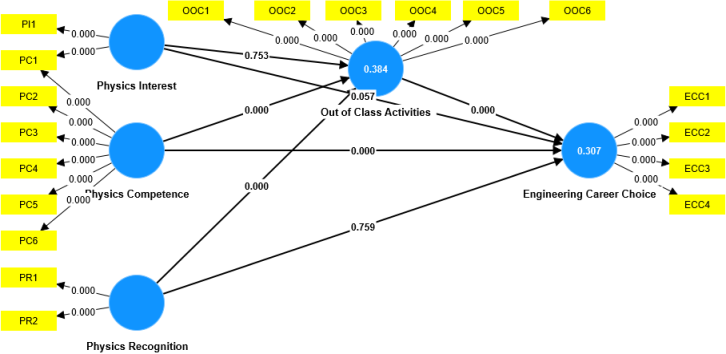
Figure 1. Graphical output of the relationship between the constructs
The results indicate that the components of identity in physics are relevant determinants and predictors of students' engineering career choices. Furthermore, the study highlights that scientific experiences acquired outside the classroom also contribute significantly to this career choice.
REFERENCES
Avraamidou, L. (2021). Identities in/out of physics and the politics of recognition. Journal of Research in Science Teaching. https://doi.org/10.1002/TEA.21721
Catren, G. (2023). Identity, individuality, and indistinguishability in physics and mathematics: Philosophical transactions, Series A. Mathematical Physical and Engineering Sciences, 381. https://doi.org/10.1098/rsta.2022.0109
Cribbs, J., Hazari, Z., Sonnert, G., & Sadler, P. (2020). College students' mathematics-related career intentions and high school mathematics pedagogy through the lens of identity. Mathematics Education Research Journal, 1-28. https://doi.org/10-1007/s13394-020-00319-w
Godwin, A., Sonnert, G., & Sadler, P. (2015). The influence of out-of-school high school experiences on engineering identities and career choice. Paper presented at 2015 ASEE Annual Conference & Exposition, Seattle, Washington. https://doi.org/10.18260/p.24889
Hazari, Z., Sonnert, G., Sadler, P. M., & Shanahan, M. (2010). Connecting high school physics experiences, outcome expectations, physics identity, and physics career choice: a gender study. Journal of Research in Science Teaching, 47(8), 978-1003. https://doi.org/10.1002/tea.20363
Kalender, Z. Y., Marshman, E., Schunn, C. D., Nokes-Malach, T., & Singh, C. (2019). Gendered patterns in the construction of physics identity from motivational factors. American Physical Society Research, 15, 1-19. https://doi.org/10.1103/PhysRevPhysEducRes.15.020119
Lock, R. M., Hazari, Z., Potvin, G. (2013). Physics career intentions: the effect of physics identity, math identity, and gender. AIP conference proceedings, 1513(1), 262-265. https://doi.org/1063/1.4789702
Lock, R. M., Hazari, Z., $ Potvin, G. (2019). Impact of out-of-class science and engineering activities on physics identity and career intentions. Physical Review Physics Education Research, 15, 1-11. https://doi.org/10.1103/PhysRevPhysEducRes.15.020137
Martin-Hansen, L. (2018). Examining ways to meaningfully support students in STEM. International Journal of STEM Education, 5. https://doi.org/10.1186/s40594-018-0150-3
Moakler, M., & Kim, M. (2014). College major choice in STEM: revisiting confidence and demographic factors. Career Development Quarterly, 62, 128-142. https://doi.org/10.1002/j.2161-0045.2014.00075X
Monsalve, C., Hazari, Z., McPadden, D., Sonnert, G., & Sadler, P. (2016). Examining the relationship between career outcome expectations and physics identity. Paper presented at Physics Education Research Conference 2016, Sacramento, CA. 228-231. https://doi.org/10.1119/perc.2016.pr.052
Piesch, H., Gaspard, H., Parrisius, C., Wille, E., & Nagengast, B. (2020). How can a relevance intervention in math support students' career choice? Journal of Applied Development Psychology, 71, 101185. https://doi.org/10.1016/j.appdev.2020.101185
Potvin, G., & Hazari, Z. (2014). The development and measurement of identity across the physical sciences. Paper presented at Physics Education Research Conference 2013, Portland, OR. 281-284. https://doi.org/10.1119/PERC.2013.PR.058
Quintana, R., & Saatcioglu, A. (2022). The long-lasting effects of schooling: estimating the effects of science and math identity in high school on college and career outcomes in STEM. Socius, 8. https://doi.org/10.1177/23780231221115405
Sar, M. (2021). The development of questionnaire to measure science, technology, engineering and mathematics (STEM) career choice: evidence from Cambodia. Cambodia Education Review, 4(2), 21-46.
Verdin, D., Godwin, A., Sonnert, G., & Sadler, P. (2018). Understanding how first-generation college students' out-of-school experiences, physics and STEM identities relate to engineering possible selves and certainty of career path. 2018 IEEE Frontiers in Education Conference (FIE), 1-8. https://doi.org/10.1109/FIE.2018.8658878
Wang, J., & Hazari, Z. (2018). Promoting high school students' physics identity through explicit and implicit recognition. Physical Review Physics Education Research.https://doi.org/10.1103/PHYSREVPHYSEDUCRES.14.020111
Conflict of interest
Authors declare no conflict of interests.
Authors' contribution
The authors participated in the design and writing of the article, in the search and analysis of the information contained in the consulted bibliography.
