 0000-0001-7609-0506
  icadamur@unap.cl
Samuel Torres Acevedo1
0009-0004-7396-8079 storres@unap.clMaritza Vergara Monardez1
0000-0002-2872-4479 mvergara@unap.cl

Mendive. Journal on Education, October-December 2025; 23(4), e4182
Translated from the original in Spanish
Original article
Community engagement for working adult students at a Faculty of Business Sciences
La vinculación con el medio de estudiantes adultos trabajadores de una Facultad de Ciencias Empresariales
Envolvimento comunitário para estudantes adultos que trabalham em uma Faculdade de Ciências Empresariais
Irving Cadamuro Inostroza1 0000-0001-7609-0506 icadamur@unap.cl
Samuel Torres Acevedo1 0009-0004-7396-8079 storres@unap.cl
Maritza Vergara Monardez1 0000-0002-2872-4479 mvergara@unap.cl
1 University Arturo Prat. Faculty of Business Sciences. Chile.
Received: 5/03/2025
Accepted: 10/10/2025
ABSTRACT
Implementing a community engagement process between adult working students in a continuing education program at the Faculty of Business Sciences and regional, productive companies presents a significant challenge and a methodological commitment for the university undertaking this process. This research applied a technical form as a tool to foster connections between adult working students graduating from the Business Engineering program in 2024 at Arturo Prat University and productive companies in Santiago, Chile. A qualitative approach was used, with an exploratory scope and an action research design. A purposive and representative sample of three students participated in an intervention process with a company, applying for the engagement form. Data were collected following the structure of the engagement form and analyzed descriptively. The main results indicated that the intervention was successful, as the working group followed the different stages of the form. The importance of community engagement between Higher Education institutions and local businesses was highlighted, as it has become a key factor in the meaningful learning of adult working students, in addition to the development of their specific and transversal skills.
Keywords: form; community engagement; adult working students; higher education.
RESUMEN
Realizar un proceso de vinculación con el medio, entre estudiantes adultos trabajadores de un plan de continuidad, de una Facultad de Ciencias Empresariales con empresas productivas y regionales, implica un gran desafío y una apuesta metodológica para la universidad que lleva a cabo dicho proceso. La investigación aplicó un formulario técnico como herramienta, para fomentar la vinculación de los estudiantes adultos trabajadores egresados de la carrera de Ingeniería Comercial del año 2024, de la universidad Arturo Prat, con empresas productivas en Santiago de Chile. Se utilizó un enfoque cualitativo, con un alcance exploratorio y desde una perspectiva de un diseño de investigación acción. Se usó una muestra intencionada y representativa de un grupo de tres estudiantes, que realizaron un proceso de intervención a una empresa, aplicando el formulario de vinculación. Los datos fueron recolectados siguiendo la estructura del formulario de vinculación y analizados desde una óptica descriptiva. Los principales resultados arrojaron que la intervención realizada fue óptima, en la medida en que el grupo de trabajo siguió las distintas etapas del formulario. Concluyó la importancia de la vinculación con el medio entre entidades de Educación Superior y empresas locales, transformándose en un factor clave para el aprendizaje significativo de los estudiantes adultos trabajadores, además del desarrollo de sus competencias específicas y transversales.
Palabras clave: formulario; vinculación con el medio; estudiantes adultos trabajadores; educación superior.
RESUMO
Implementar um processo de engajamento comunitário entre estudantes adultos que trabalham em um programa de educação continuada da Faculdade de Ciências Empresariais e empresas produtivas regionais representa um desafio significativo e um compromisso metodológico para a universidade que empreende esse processo. Esta pesquisa aplicou um formulário técnico como ferramenta para fomentar conexões entre estudantes adultos que trabalham e se formam no programa de Engenharia Empresarial em 2024 da Universidade Arturo Prat e empresas produtivas em Santiago, Chile. Foi utilizada uma abordagem qualitativa, com escopo exploratório e delineamento de pesquisa-ação. Uma amostra intencional e representativa de três estudantes participou de um processo de intervenção com uma empresa, aplicando o formulário de engajamento. Os dados foram coletados seguindo a estrutura do formulário e analisados descritivamente. Os principais resultados indicaram que a intervenção foi bem-sucedida, visto que o grupo de trabalho seguiu as diferentes etapas do formulário. Concluiu-se que a importância da articulação com o ambiente entre instituições de ensino superior e empresas locais é um fator-chave para a aprendizagem significativa de estudantes adultos que trabalham, além do desenvolvimento de suas competências específicas e transversais.
Palavras-chave: formulário; envolvimento comunitário; estudantes adultos trabalhadores; ensino superior.
INTRODUCTION
The research is being conducted at the Teaching and Outreach Center of Arturo Prat University in Santiago, Chile, within a weekend continuing education program for working adult students in the Business Engineering program, offered by the Faculty of Business Sciences. This academic program is offered in the evenings and is modular. Students take one course per month. Classes are held on Fridays from 7:00 pm to 10:00 pm and on Saturdays from 8:30 am to 3:30 pm.
The students attending the program have an average age of 35. With multiple family and work responsibilities, they decide to resume their formal education, which they left more than 10 years ago for various reasons. The goal is to acquire new academic skills and, in the process, obtain a professional degree to meet the evolving demands of a politically, economically, technologically, and sustainably evolving society.
The faculty members who teach in this program are professionals with expertise in various areas of business administration, economics, finance, accounting, project evaluation, microeconomics, human resource management, technology development, logistics and transportation, among other subjects. Most hold operational and strategic positions in the companies where they work. They are accustomed to meeting objectives and achieving concrete results. Their daily activities consist of meetings, focused on the efficient use of resources.
As teachers, within the classroom, they teach as they were taught in their original fields. They lack formal training in education, let alone in teaching strategies, assessment techniques, and curriculum development. They also lack clarity on how to approach the educational process for working adult students. They conduct their classes using a traditional, rote approach, prioritizing teaching over learning.
Arturo Prat University is a higher education institution belonging to the Council of Rectors of Chile. Its main campus is in the north of the country, specifically in the city of Iquique. It is currently accredited at the advanced level until 2027 in the areas of institutional management, undergraduate teaching, and community engagement. This last area reports to the Rector's Office and aims to formulate and propose strategic programs and projects that expand and diversify the institution's activities in the Tarapacá Region and at its various Teaching and Community Engagement Centers and campuses nationwide (Unap, 2025).
The university has seven faculties, all of which develop their academic programs in accordance with the institution's educational model and under the guidelines of the National Commission for Accreditation of Higher Education in Chile; the Faculty of Business Sciences is one of them. For over 40 years, it has offered traditional undergraduate programs and continuing education programs for working adults nationwide.
Continuity programs for adult working students have been a priority for the Faculty of Business Sciences, but only from the perspective of providing instruction to such a specific group of students. However, the new guidelines of the National Accreditation Commission require progress in institutional academic work, not only by teaching classes, but also by linking the university with its environment and territory through projects and connections in research, disciplinary, artistic, technological, and productive areas, thus promoting its positioning and social role, committed to the mission of the educational institution (Unap, 2025).
Law 20129, published on November 17, 2006, in Chile, regarding the accreditation process of higher education institutions, specifically in Title II, Article 15, refers to the accreditation process for autonomous higher education institutions. This process consists of evaluating and verifying compliance with quality criteria and standards in accordance with the mission and purposes of each educational institution. These criteria and standards relate to the institution's own resources, processes, financial, administrative, and, primarily, academic matters (National Accreditation Commission of Chile, 2024).
Article 17 of the institutional accreditation guidelines states that all higher education institutions entering the quality assurance process must first be accredited in undergraduate teaching and institutional management. They may then pursue accreditation in areas such as research, postgraduate teaching, and community engagement.
Community engagement is one of the fundamental pillars for the accreditation of any higher education institution. This is according to Colther. et al. (2020) in a study conducted at the Austral University of Chile, when they point out the relevance of deepening and strengthening the links of the university and its various academic programs, through the entrepreneurial spirit of undergraduate students with their local environment.
Colther et al. (2020) conclude that effective learning processes and expanded national and international collaboration networks can be achieved through partnership projects with companies. A culture of community engagement in universities also allows students to develop skills and competencies to prepare them for the workforce. Finally, they pose a challenge for educational institutions: to create curricula that incorporate the development of new businesses through community engagement.
The case of the University of Aysén in Chile highlights the importance of higher education institutions and their connection to the community. It took more than 70 years for the Chilean state to decide, in 2015, to create a university with a regional focus that addresses the needs and provides educational opportunities to the local area through knowledge generation, building trust with the community, and the capacity to generate endogenous knowledge, in order to attract advanced human capital and investment (Rivera et al., 2021).
Social innovation and university teaching are integral to community engagement, as they help solve community problems, improve reciprocal relationships, and strengthen collaborative and innovative processes. The study by Saldias et al. (2020) concludes that social innovation acts as a strategy aimed not only at developing university teaching within a framework of interaction with the local community, but also at contributing to curriculum adjustments through program redesigns.
The conclusions of Albornoz and Barrere (2020) complement the view of Saldías et al. (2020). At the Latin American level, the proportion of cooperative agreements between universities and R&D centers to develop innovation and transfer this knowledge to related companies is low. This phenomenon is due to the focus being on obtaining information and training, rather than on developing R&D. Hence the importance of creating regional public policies that foster innovation and address local problems in public services such as transportation, education, housing, health, and so on. These policies should engage companies in the sector and, consequently, with international innovations.
Salazar's (2020) perspective indicates that universities and their relationship with the community are not on the minds of social movements or political education commissions, much less in Chilean scientific literature. However, various institutions, such as the National Accreditation Commission, which guarantees the quality of education in Chile, have opened spaces and revealed the importance of community engagement processes, since these processes generate knowledge, negotiate interests, and identify and solve problems with social actors. This last point is shared by Saldías et al. (2020), who state that the final product of this symbiosis contributes to creating mechanisms that support territorial development and go beyond purely economic development.
At the Latin American level, universities have made progress in developing innovative policies and institutional models that address the implications of community engagement from a scientific and technological perspective. In this sense, they aim to respond to the social mission and traditions of the institution in relation to the territory in which they are located. Furthermore, decentralization in community engagement management is necessary, as well as a focus on science and technology engagement policies that transform local processes, solve problems, and foster productive partnerships within the region (Di Meglio, 2022).
A study conducted by Rueda et al. (2020) of 60 public and private Ecuadorian universities indicates that the main activities related to community engagement are social action and continuing education. However, activities related to business development and technology transfer are the least developed. Finally, 25% of the educational institutions consider alumni tracking to be a community engagement practice.
The project benefits working adult students by applying theoretical and practical knowledge to real-world cases in companies within the region. It also facilitates external evaluation of the university, based on the feedback of an executive from the participating company, regarding the students' performance and contributions.
The research will be a contribution to the academics of the Faculty of Business Sciences of the Arturo Prat University, as it allows comparing classroom evaluation with external evaluation by an executive of the intervened company, as a form of feedback for their teaching management in the subject. Finally, the study fulfills one of the strategic quality objectives of the Arturo Prat University, which is the connection with the environment; since this activity allows adult working students to contribute to the company through the application of their knowledge, through advisory work.
The research aims to apply a technical form as a tool to promote the connection of adult working students who graduated from the Commercial Engineering program in the second semester of 2024, from the Arturo Prat University, with productive companies in Santiago, Chile.
MATERIALS AND METHODS
The study employed a qualitative approach with an exploratory scope and an action research design. This model allows for the ongoing analysis of problems and the understanding of practices carried out in the daily life of educational institutions and the work of teachers within the classroom (Kemmis & McTaggart, 1988). Furthermore, the methodology was based on Schön `s reflective paradigm (1992), which highlights the importance of educational practice as a reflective activity that enables teachers to confront and address practical problems in the educational field and within the classroom.
A purposive and representative sample was used from the work carried out by a group of three students from the Business Engineering program, enrolled in a continuing education program at the Teaching and Outreach Center in Santiago, Chile, during the second semester of 2024. The data was collected by the team members, based on the outreach form described in the results of this research. The data analysis was conducted from a descriptive perspective of the applied form and the case study.
The investigation found limitations on the part of the company regarding the inclusion of sensitive information about processes, procedures, rules, and policies in the onboarding form, information that could be misused without their consent. The company also expressed concern about revealing its weaknesses in the onboarding form and having them made public. For ethical reasons, the study was forced to redact the company name and the identification of its legal representatives and their corresponding signatures in black. Additionally, one of the surnames of the students who participated in the intervention was removed. The full identification of the university faculty members was retained.
The inclusion criterion was a single case from a group of students who graduated from the continuing education program in Business Engineering, specializing in business administration, in 2024. Exclusion criteria excluded cases from other programs and cohorts within the Faculty of Business Sciences. The thematic analysis, document searches, and publications in the field of Higher Education were conducted using UNESCO Thesaurus.
RESULTS
The research findings were detailed in the different stages of the form using the following attached figures (Figure 1).

Figure 1. Agreement between the company and the Faculty of Business Sciences
Source: Faculty of Business Sciences, Arturo Prat University
This section of the form began with the general data of the company to be involved, such as company name, tax ID and address, as well as its legal representatives.
The form continued with general information about the course from which the intervention work originated, the name of the degree program, and the location where it is taught. In this case, the activity took place within the graduation project course, which belongs to the Business Engineering program, specializing in business administration, at the Teaching and Outreach Center in Santiago, Chile. The course and program codes were also detailed.
Subsequently, the name of the academic supervising the course and the title of the project were identified. Additionally, the objective and some general descriptions of the work were outlined. On this occasion, the team proposed a strategic alignment of values, processes, and organizational transformation for a company dedicated to the production of tartaric acid and the recycling of wine waste. Finally, the start and end dates of the intervention were identified, as well as the names and national identification numbers (RUT) of the students who participated in the project. The engagement form then included a section regarding the expected learning outcomes of the academic program, which, in turn, had to be aligned with the work to be carried out by the students. These were: the application of organizational diagnostic methodologies, the evaluation of organizational climate and culture, and the promotion of transformational leadership. Finally, the form included a section with the competencies that the course expected students to acquire during the development of their intervention project; these were: effective communication, research skills, and interdisciplinary teamwork (Figure 2).
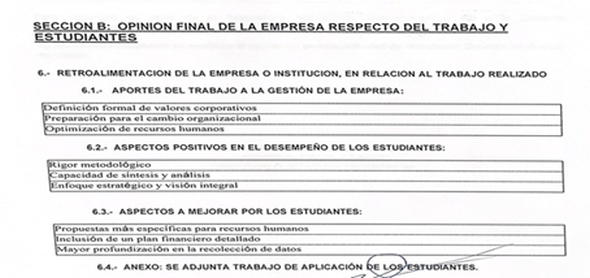
Figure 2. Final opinion of the company regarding the work and students
Source: Faculty of Business Sciences, Arturo Prat University
This section of the form considered contributions to management, positive aspects in student performance, and issues for improvement by the latter.
From a management perspective, the company considered the student group's work beneficial to optimizing human resources, fostering a positive approach to organizational change, and reinforcing corporate values among company personnel. Furthermore, the institution expressed a favorable opinion regarding the methodological rigor employed by the students in their work, highlighting their analytical and synthesis skills from a strategic and comprehensive perspective. However, the organization identified areas for improvement, including developing a more specific proposal for human resources, more in-depth data collection, and incorporating a detailed financial and economic plan.
The section concluded with the students' application work. In this part, the company's contact information was stamped with a seal and signature (Figure 3).
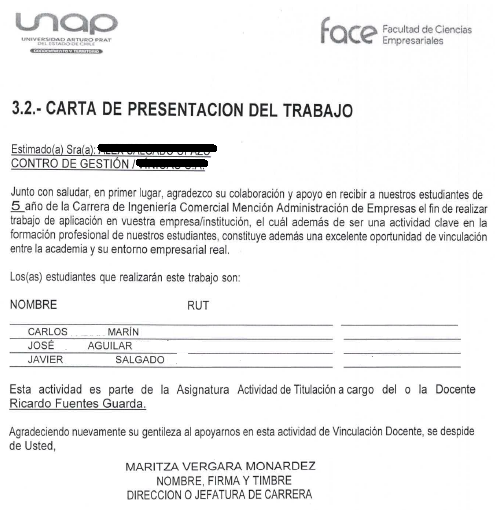
Figure 3. Cover letter for the intervention work
Source: Faculty of Business Sciences, Arturo Prat University
Based on this document, the group formalized its relationship with the company where it carried out its intervention work. A representative from the Business Engineering program, specifically the program director, sent the letter to the company's legal representative. In many cases, this representative is also the supervisor of one of the group members. Additionally, the objective of the activity and the participating students were identified. The academic advisor responsible for guiding the work was also documented. Finally, the program director validated the process with their signature and official stamp, confirming that it was carried out according to the established guidelines (Figure 4).
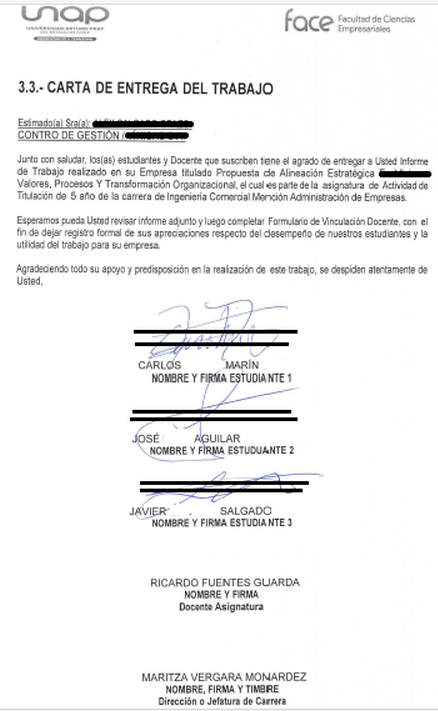
Figure 4. Letter of delivery of the work to the company
Source: Faculty of Business Sciences, Arturo Prat University
At this stage of the process, the academics responsible at the educational institution formally submitted the final report to the company representatives. Finally, the signatures of the group members and the university representatives were affixed.
DISCUSSION
The findings confirm the achievement of the stated objective. The applied questionnaire validates the importance of engagement as an essential strategy in the education of adult working students. Through this tool, the educational institution, with its student-centered educational model and competency-based approach that integrates academia with its regional environment, generates a tangible impact on both students and local productive sectors.
The experience of Arturo Prat University underscores the importance of addressing the specific needs of regional productive sectors. As Saldías et al. (2020) argue, this collaboration not only resolves local problems but also fosters the development of practical skills in students, preparing them to face the challenges of the labor market. This is evident in section B of the collaboration form, where the company provides feedback on the work carried out by the students.
In line with the findings of Colther et al. (2020), Arturo Prat University demonstrates that its community engagement programs not only strengthen the professional training of its students but also generate collaborative networks that benefit local communities. Its advanced accreditation until 2027 reflects its commitment to educational quality and its mission to contribute to the social and economic development of the Tarapacá region and other territories where it has a presence. Furthermore, Arturo Prat University's community engagement demonstrates that regional universities can overcome the limitations identified by Albornoz and Barrere (2020) regarding the sustainability of collaborations with productive sectors. The institution's strategy, by integrating this area into its institutional plan, shows that it is possible to bring its educational model into the classroom to contribute to student learning and, consequently, to the development of local communities. This is further reinforced in this research through the application of the questionnaire to address a specific problem in the wine sector, suggesting its applicability to various business areas. The company's feedback, section B and point 6.1, reinforces what has been said.
In line with Di Meglio (2022), decentralization and territorial focus are key factors in the success of Arturo Prat University. The initiatives designed to address the needs of the cities of Tarapacá and Arica reaffirm the institution's role as a leader in territorial engagement in Chile. Furthermore, the documentation and publicizing of these practices position it as a key player in the discussion about the role of universities in social development. While the institution's main campus is in northern Chile, the survey was administered to a program at the Teaching and Outreach Center in Santiago, located more than 1,700 kilometers away. This demonstrates that the tool can gather relevant information from any productive sector, regardless of its location.
The study concluded that community engagement had a positive impact on the education of adult working students at the Faculty of Business Sciences of Arturo Prat University. The application of the engagement form strengthened the relationship between academia and the productive sector, facilitating knowledge transfer and the development of professional skills in a real-world context. The findings indicated that the intervention was effective, as the stages defined in the form were completed, providing a structured framework for integrating learning with the needs of the business environment.
From a methodological perspective, the study reaffirmed the relevance of the qualitative approach, with an action research design, in community engagement studies between Arturo Prat University and regional businesses, particularly when analyzing academic training in continuing education programs for working adult students. This allowed for a general understanding of the processes involved, highlighting the importance of educational practice and continuous improvement in business management education. Finally, the research provided empirical evidence on the relevance of linking higher education with local production dynamics, becoming a benchmark for future research on educational innovation and university engagement in a national and Latin American context.
REFERENCES
Albornoz, M., & Barrere, R. (2020). Introducción. El desafío de la innovación y la vinculación. https://www.researchgate.net/publication/370600166
Comisión Nacional de Acreditación. (2024). https://www.cnachile.cl/Paginas/Inicio.aspx
Colther, C. M., Fecci, E., Cayun, G., & Rojas-Mora, J. (2020). Enseñanza de la cultura emprendedora en la universidad: El caso de la Universidad Austral de Chile. Formación universitaria, 13(4), 129-138. http://dx.doi.org/10.4067/S0718-50062020000400129
Di Meglio, F. (2022). La vinculación científico-tecnológica ¿hacia una perspectiva territorial y focalizada? Experiencias recientes en las universidades argentinas. Entramados: educación y sociedad, (12), 76-92.
Kemmis, S., & McTaggart, R. (1988). Cómo planificar la investigación-acción. https://www.sidalc.net/search/Record/KOHA-OAI-FCF:15003/Description
Rivera-Polo, F., Rivera-Vargas, P., & Alonso-Cano, C. (2021). Ni nacional, ni empresarial: legitimidad territorial universitaria. El caso de la Universidad de Aysén en Chile. Izquierdas, 50. https://www.scielo.cl/pdf/izquierdas/v50/0718-5049-izquierdas-50-12.pdf
Rueda, I., Acosta, B., & Cueva, F. (2020). Las universidades y sus prácticas de vinculación con la sociedad. Educação & Sociedade, 41, e218154. https://doi.org/10.1590/ES.218154
Salazar Alvarado, D. (2020). La vinculación con el medio en la Universidad de Santiago de Chile. El alcance territorial de los proyectos financiados entre 2018 y 2020. Revista de extensión universitaria, (13). https://doi.org/10.14409/extension.2020.13.Jul-Dic.e0017
Saldías, C. C., Sánchez, G. S., & Aguilar, C. R. (2020). Innovación social en la docencia universitaria: una estrategia de interacción academia y sociedad. Revista Venezolana de Gerencia: RVG, 25(4), 347-363. https://dialnet.unirioja.es/servlet/articulo?codigo=8890418
Schön, D. (1992). La formación de profesionales reflexivos. Hacia un nuevo modelo de enseñanza y del aprendizaje en las profesiones. Paidos. https://josegastiel.wordpress.com/wp-content/uploads/2019/02/schc3b6n-la-formacion-de-profesionales-reflexivos-donald-schon.pdf
Unap. (2024). https://www.unap.cl/prontus_unap/site/edic/base/port /direccion_vinculacion.htm
Conflict of interest
Authors declare no conflict of interests.
Authors' contribution
The authors participated in the design and writing of the article, in the search and analysis of the information contained in the consulted bibliography.
